|
|
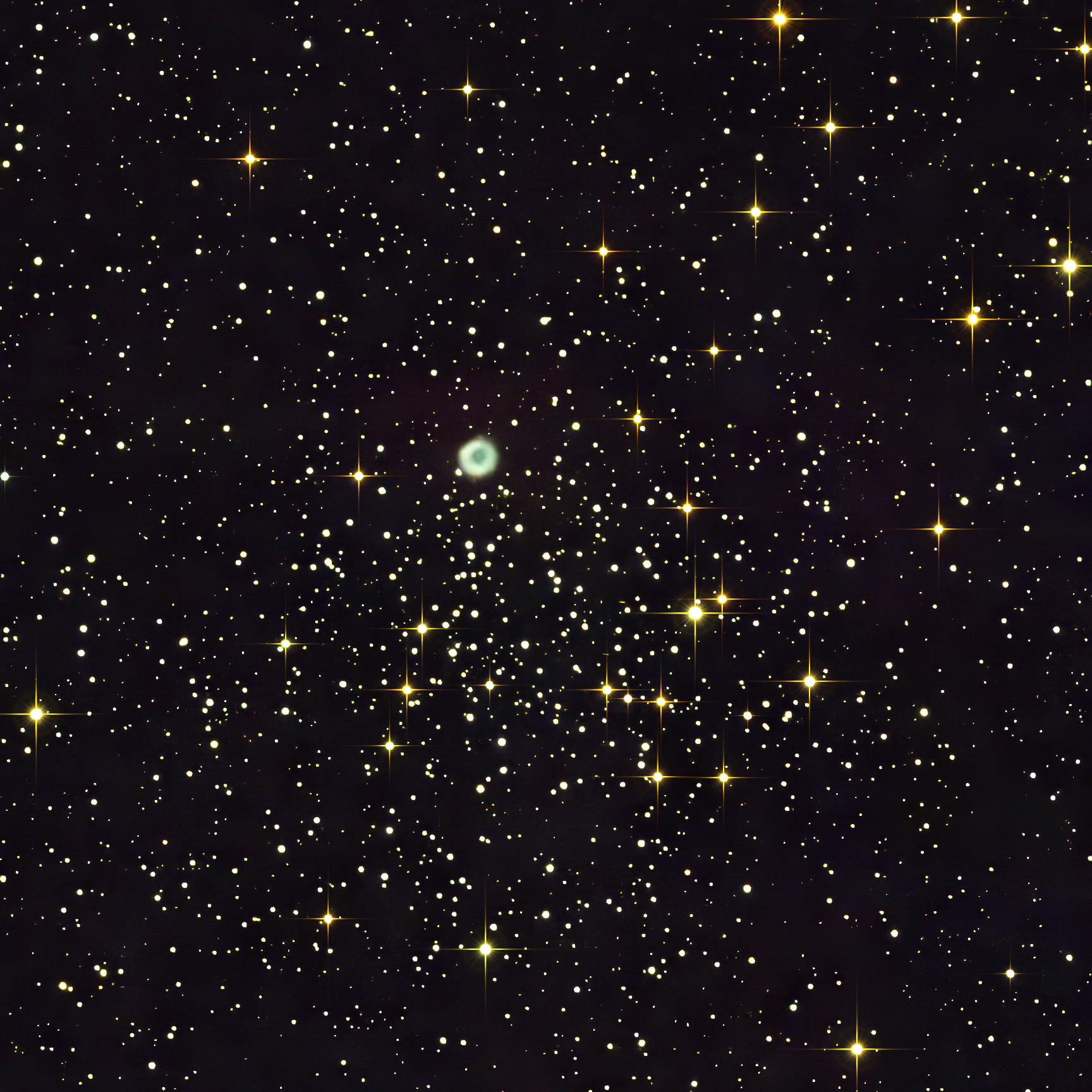
M46 with embedded planetary nebula NGC 2438 on February 08, 2026 |
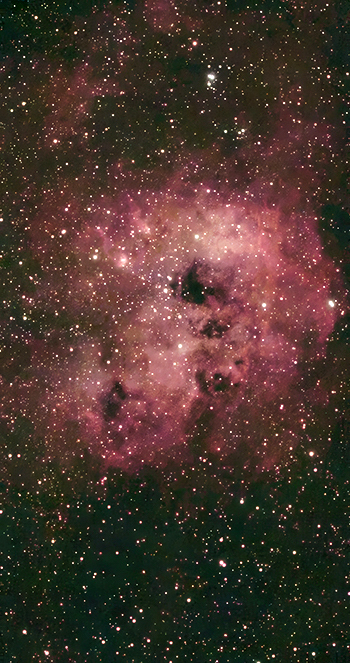
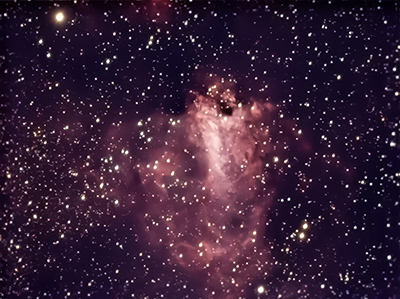
Tadpole Nebula IC 410 in Auriga on February 08, 2026
(click above images to see detailed rendering -- be patient while the large, high resolution image loads) |
In late 2025 I participated in local educational opportunity called True Kids 1. It offers "after-school programs that are free and open to all middle-and high-school students in the county." According to their mission statement, "we provide food, job training, hourly stipends -- and most importantly a place to be and to belong."
I was asked by Director of Media Pete Monro if I could provide some background astrophotographs for one of the films, "Ancestral Skies." Of course I proudly agreed. Below is a link to this outstanding film. It was shown along many of the student's works, at their Test of Time Media contest on the evening of December 11, 2025 at the Taos Center for the Arts. All the shorts were really outstanding, including an extremely powerful one of "On Hunger" (locally) and the outstanding "Mudding the San Francisco de Asis Church" the local yearly tradition of mudding the adobe face of this very historic, famous, and photogenic northern New Mexico building. The kids did virtually everything; the choice of subject, scripting, interviewing, filming, editing -- essentially creating their entire project. Did you know that the local High School has the typical marching and concert band of course, but also a Mariachi band?
Below is the link to the "Ancestral Skies" film, describing the lament and possible solutions to even our small town's difficulty with light pollution.
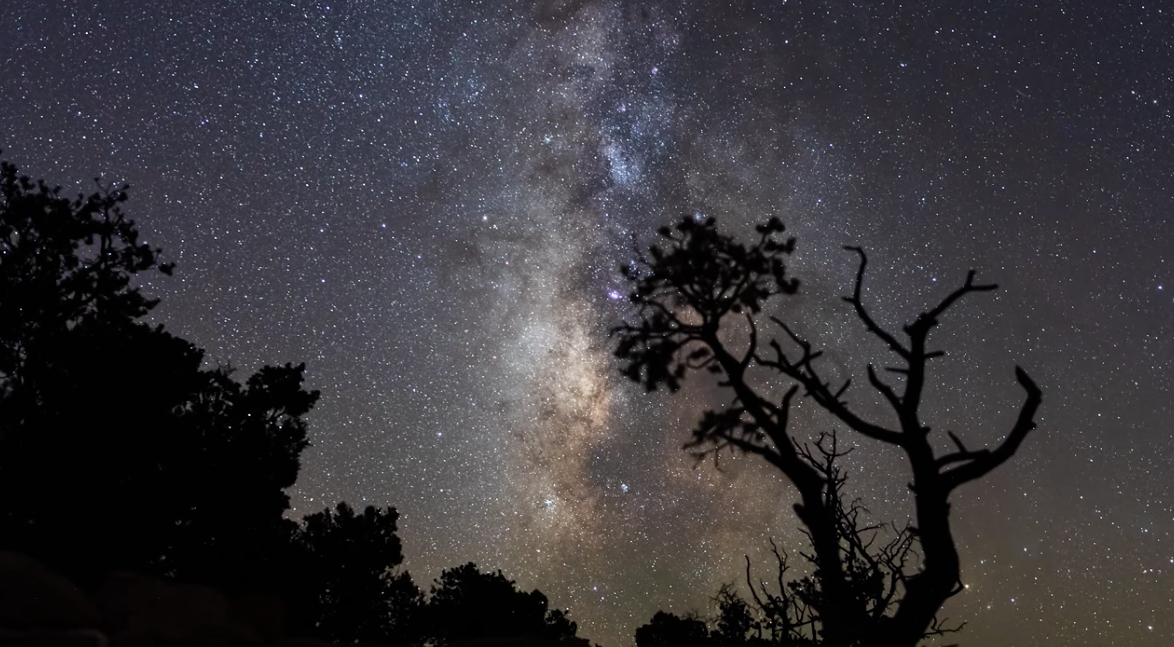
(This segment above courtesy "Ancestral Skies"/Pete Monro/TrueKids1)
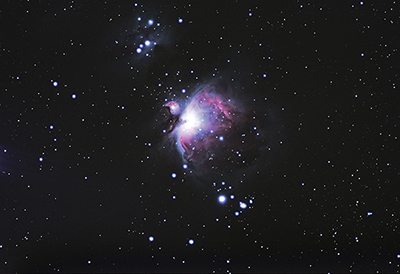
My son Larry's latest astrophotograph of the Orion Nebula, M42, taken in January 2026 from his backyard in Centennial, Colorado. Click the astrophoto to link to his site.
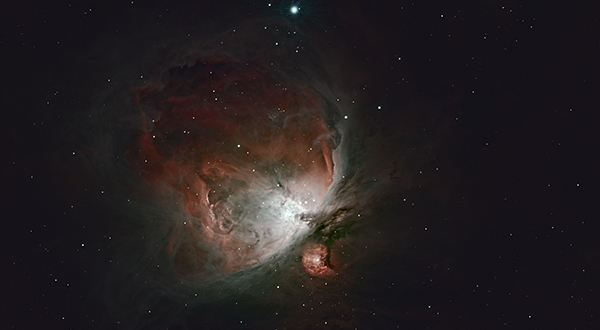
(image ©Lawrence Greiner 2026)
Brand new -- ZWO Seestar S50 has its own page of expanding content! Click on this text!
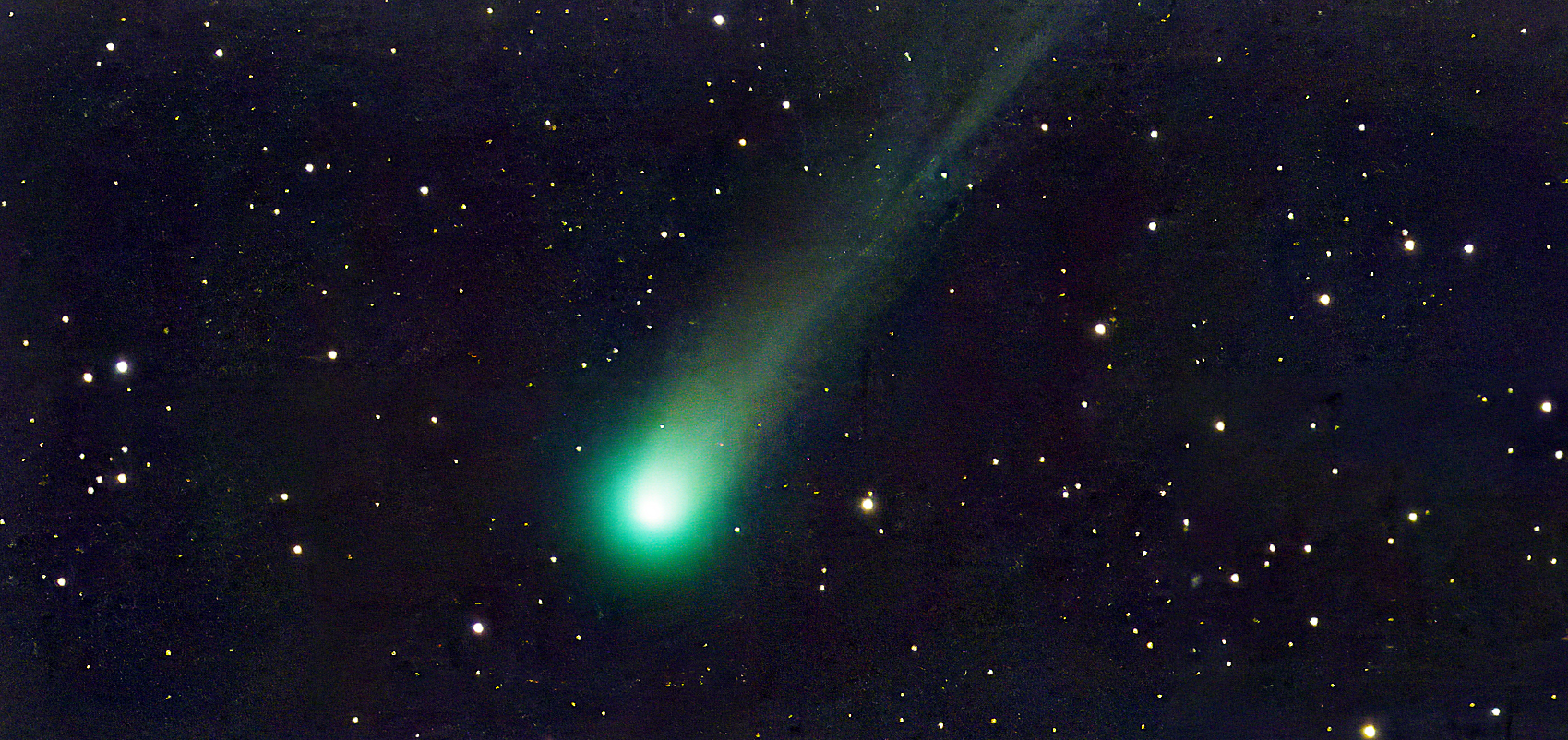
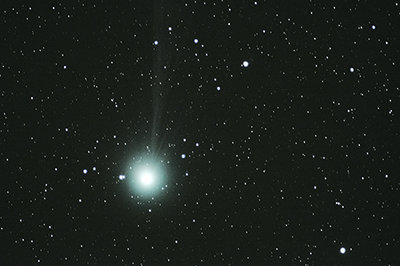
New Comet visible October, 2025 and other new Seestar images -- click on this text or the Comet Lemmon image below!
Click here for the final Comet Lemmon image, taken at its closest approach on October 21st, 2025! (Large images, please be patient with the unavoidable download of several seconds for this entire page.)
|
|
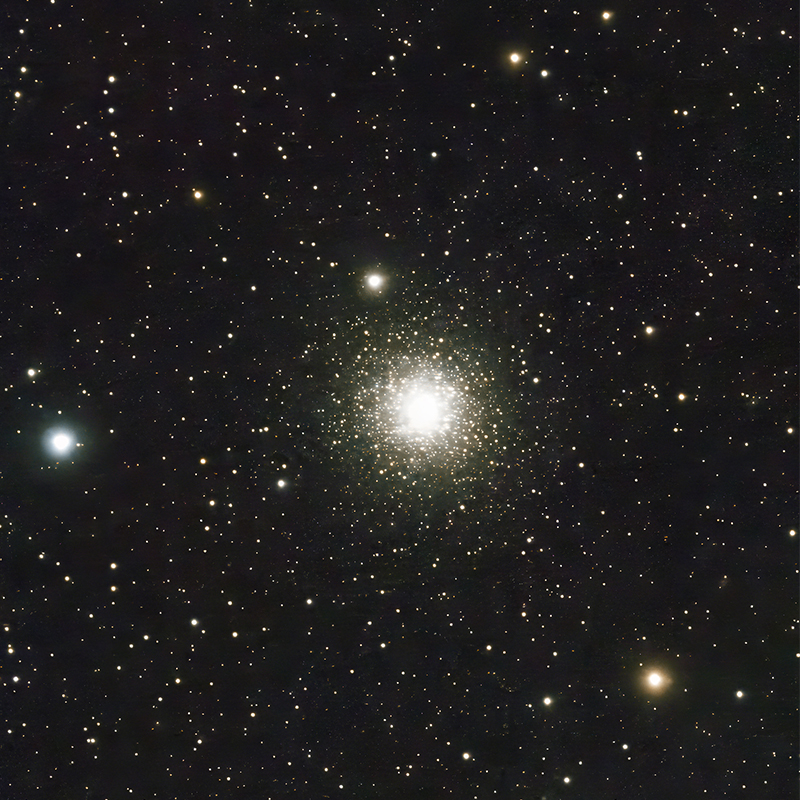
M15 on December 13, 2025 |
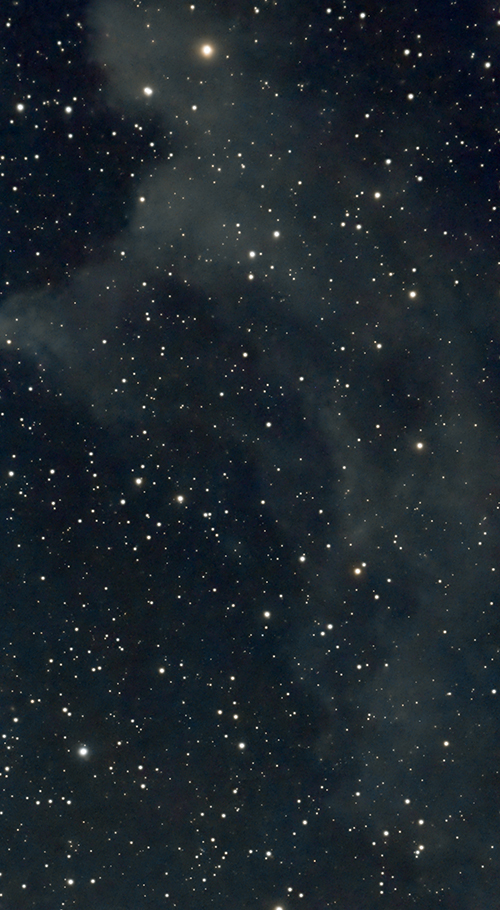
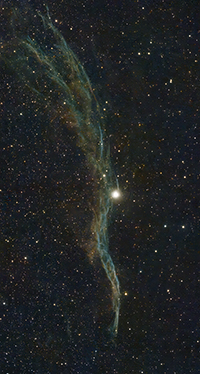
Witch Head Nebula NGC 1909 (click above image to see detailed rendering -- be patient while the large, high resolution image loads) |
|
|
 |
Comet Lemmon on October 03, 2025 |
best Seestar S50 image yet -- Iris Nebula (click above image to see detailed rendering -- be patient while the large, high resolution image loads) |
new high-res image of the Western Veil Nebula -- click image for large rendering |
New Seestar Adventures -- September, 2025
Most recently, I have been working with the ZWO Seestar S50 -- practicing setting up (easy when it is daytime), aiming at the Sun and Moon and even taking some astrophotographs. Below are some of the results.
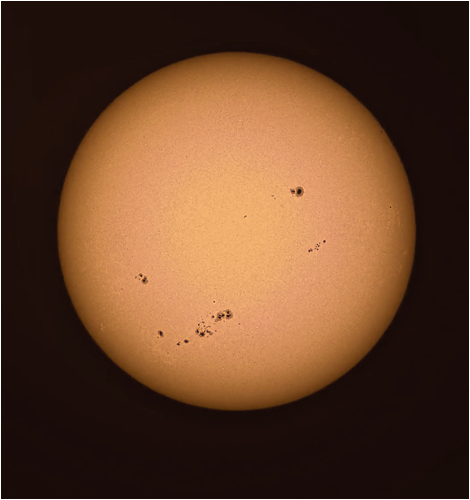
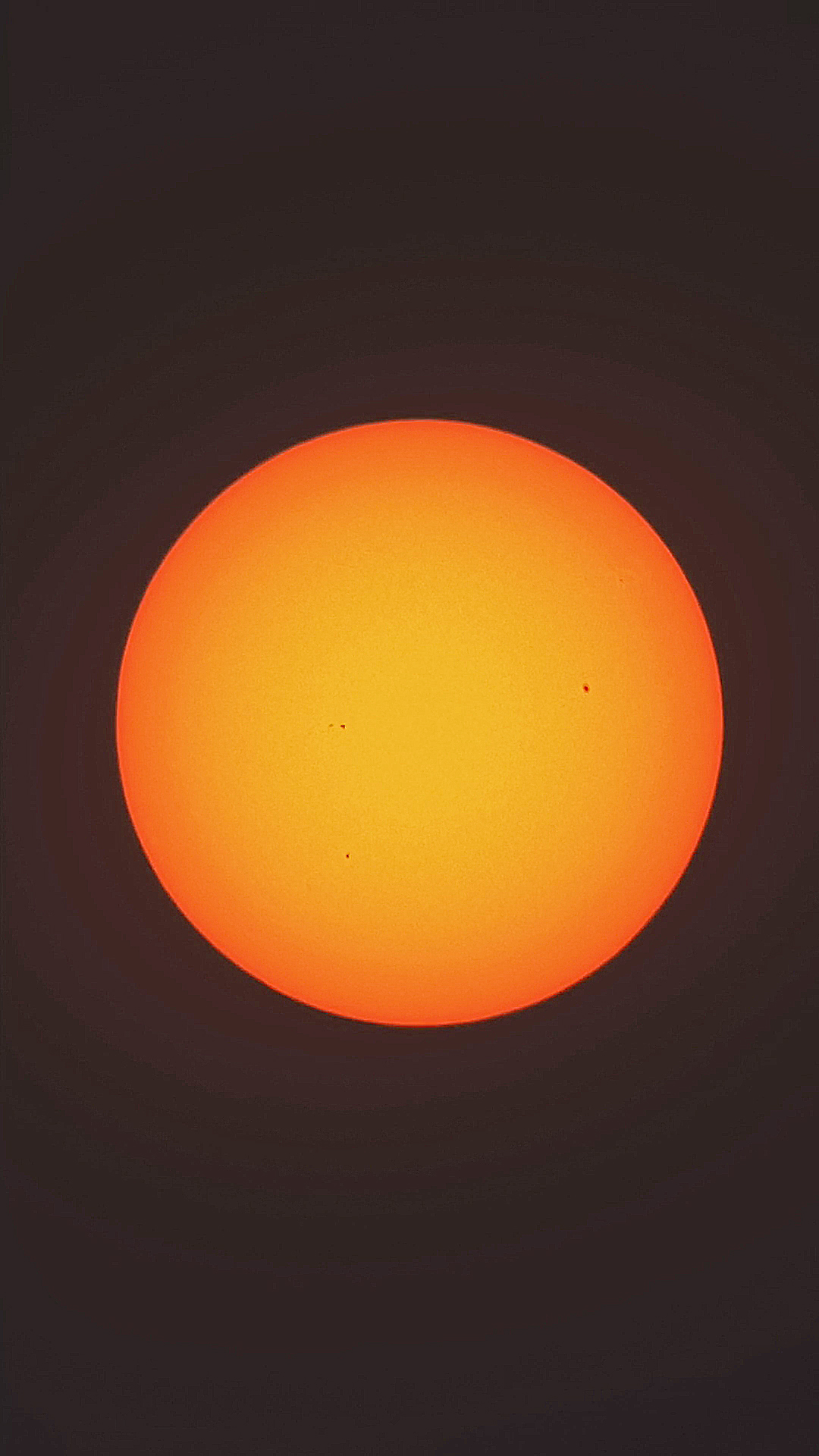
This solar image was taken on August 28, 2025 and was acquired from the newer Android tablet (which ”talks to” the Seestar instrument) and adjusted for color as the filters for the Sun are not yellow-orange) and sharpened in PhotoShop. Data attached to the original .tif file, as all below. Automatic aiming didn’t work, so I used the simple solar manual aiming device.
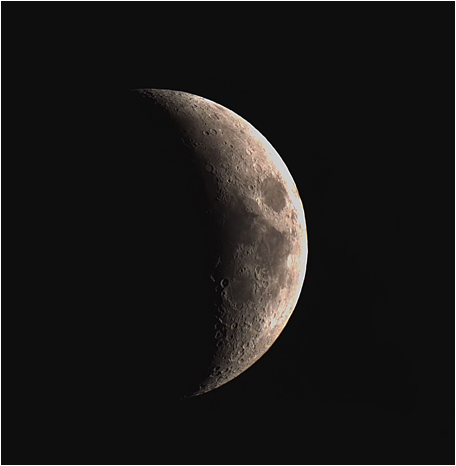
This image of the Moon was also brought into PS and sharpened a bit, since it is not a stack but instead a singular image. Also, it is cropped, as the typical output for the Seestar is vertical and somewhat narrow. All of the deep sky pics below will be presented in that original format but reduced in size.
The automatic aiming also failed to find the Moon, but after some difficulty the Seestar was aimed manually (somewhat difficult) and then no problem. I believe that the EQ option is an issue (perhaps caused by less-than-perfect setup and questionable settings by the operator!), so I then decided after some failed guiding to set up the Seestar in Alt-Az mode on the small tripod and take multiple 10-second exposures per the original instructions. As is noted below (essentially all 5-minute/30 each 10-second exposure automatic stacks, very, very few rejects); the deep-sky experiments turned out very well, I’d say.
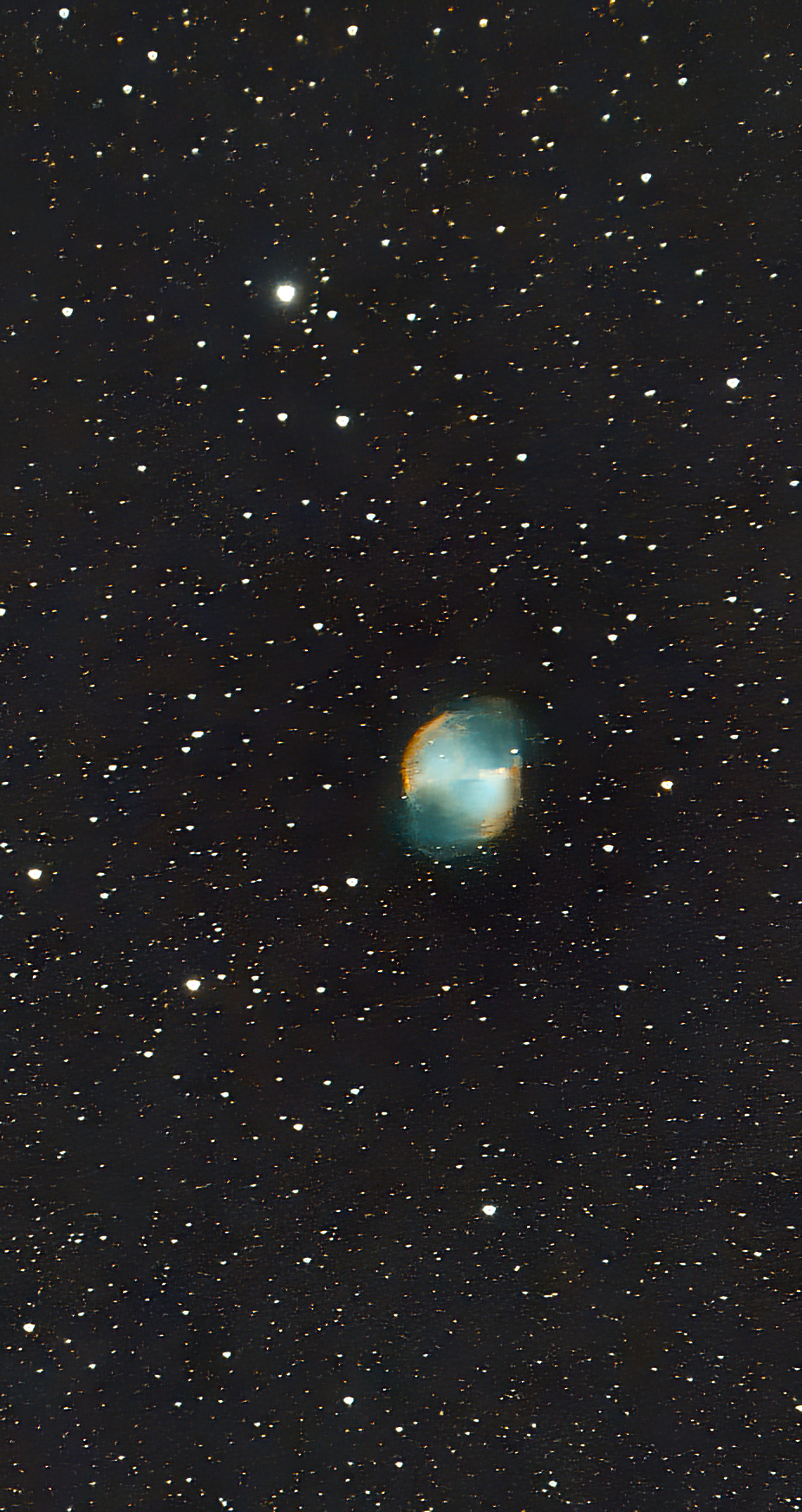
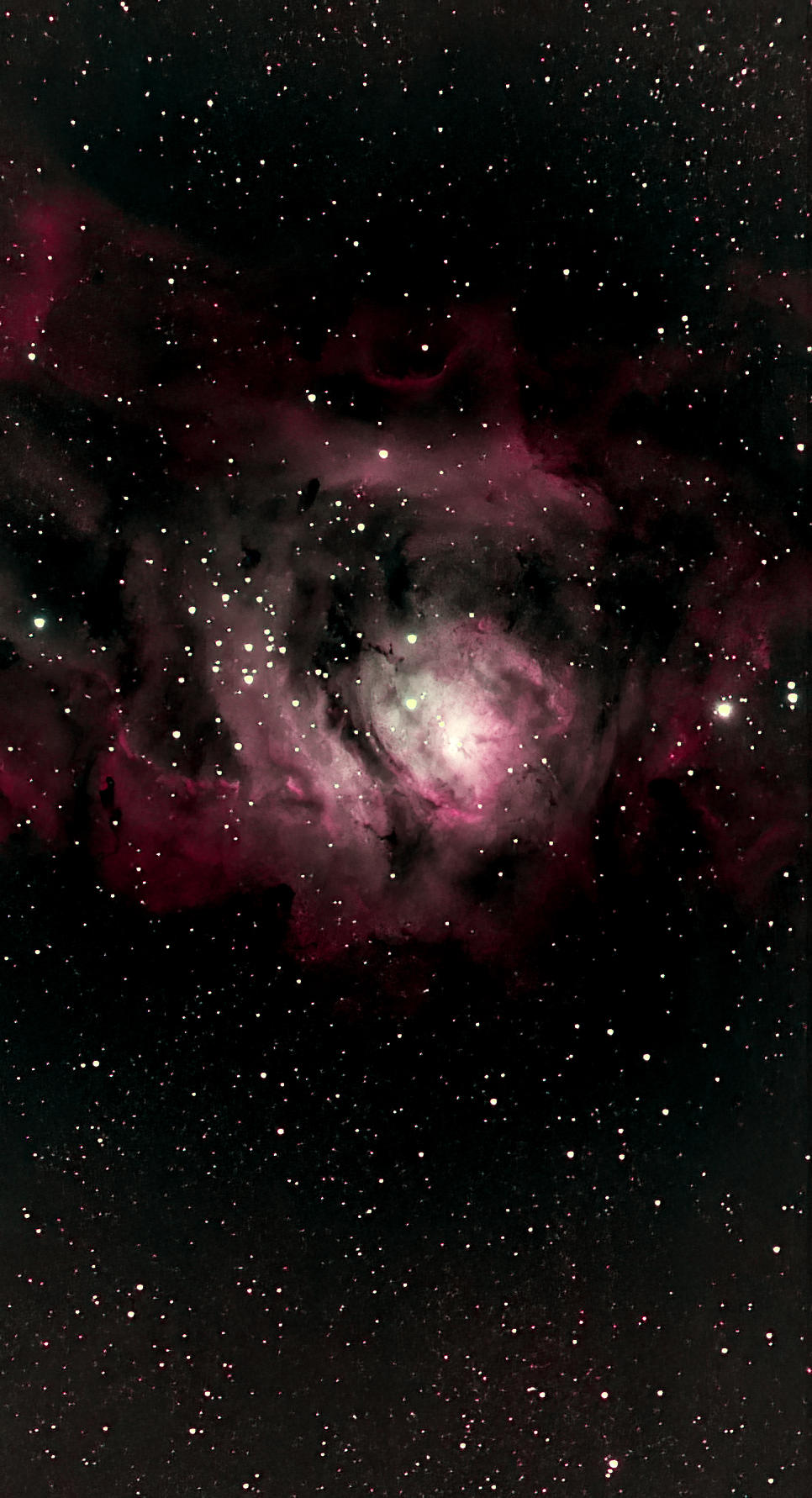
I reduced the size a bit on these verticals to add room for comments. Above is planetary nebula M27, using the EQ setup before changing. All PS alterations are listed in the original .tif save file. Great color, not great but OK guiding given the equipment! No cropping, just size reduction. Note centering of object by the on-board software -- perfect!
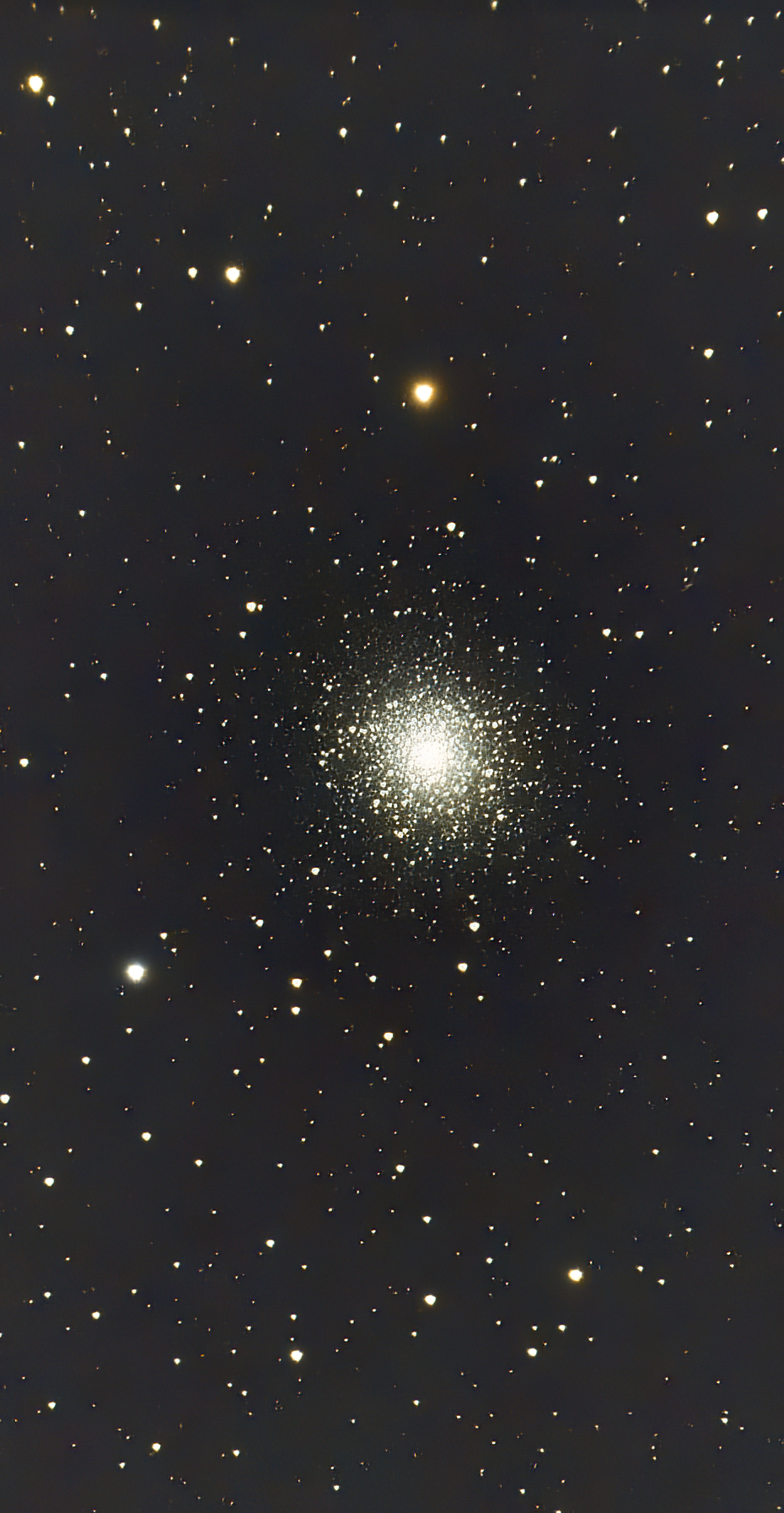
Pictured here is globular cluster M13 in Hercules. Color pretty good, although perhaps a bit too green. These images must be cropped a little because of the rotation of the Earth doesn’t completely fill the frame. Here that phenomenon was unfortunate, as I had to crop out a tiny galaxy that was visible upper right. The resolution of the cluster is excellent for such a small telescope, due also partially to the size of the imaging chip.
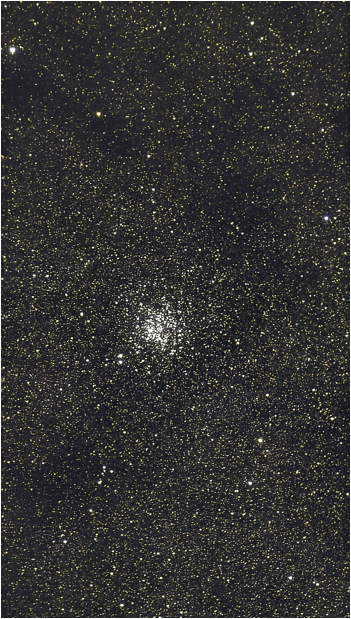
Presented above is an open star cluster in Scutum (M11), against the backdrop of the center of our galaxy, the Milky Way. Because of that the entire image is certainly full of stars, with an impressive cluster centrally located. Note the dark lanes visible and somewhat devoid of the blocked light of stars beyond.
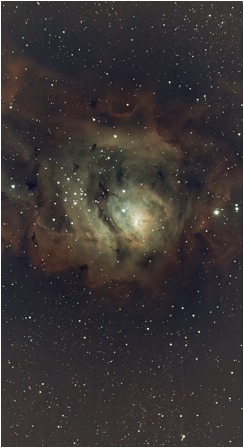
|
|
|
original post-processing |
after “removal” of much of the yellow/green tinge |
continued post-processing to achieve a more "traditional" image -- I prefer the previous rendition |
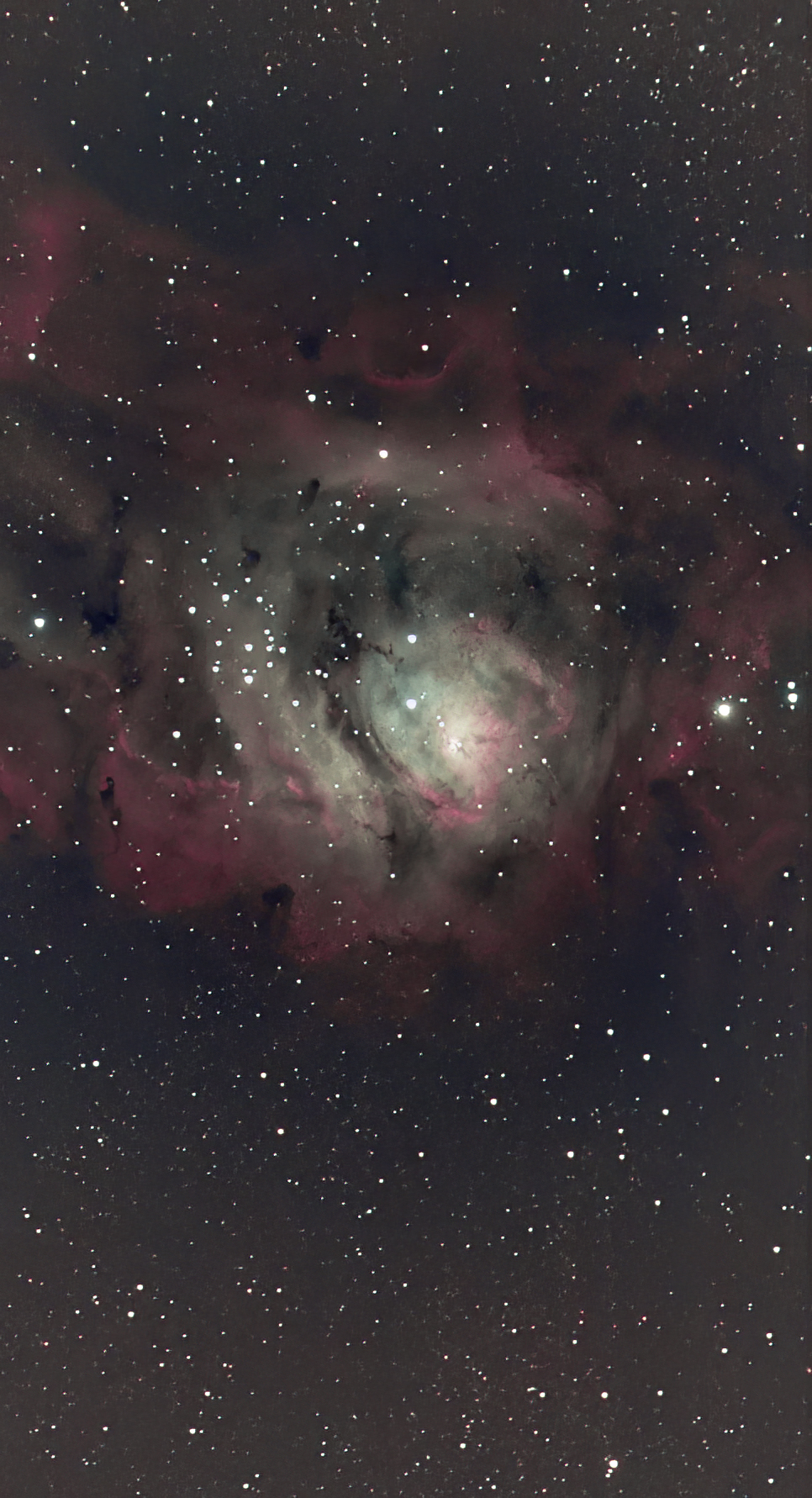
The subject is M8, cluster and nebulosity in Sagittarius. I adjusted it in three ways because I did not prefer the greenish cast, likely due to some light pollution and possible due to the automatic use of the Seestar’s light-pollution filter, which could produce such color anomalies. Because of this, I redid the original file (all adjustments in the original .tif file) and reproduced here. I may rework it again, but I’m trying not to make the use of the Seestar too labor-intensive in the post-processing realm. Below (left) the quasi-final (for now) image is shown.
Note in this final image the amazing dark bok globules and detail within the nebula. According to a description on the internet:
“Bok globules are isolated and relatively small dark nebulae containing dense cosmic dust and gas from which star formation may take place.”
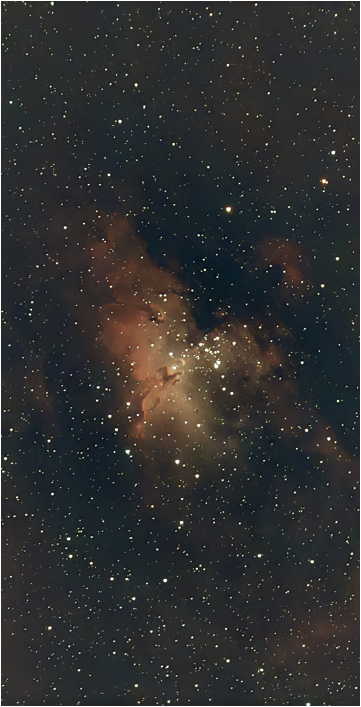
Such globules are also evident in the final photo (above right) of the evening, M16, also in Sagittarius. These globules in this so-called Eagle Nebula have been called the “Pillars of Creation,” the name given the enlargement of this area of the sky taken by the Hubble telescope.
It’s wonderful and technically amazing that such detail can be seen -- even with such a modest instrument in a short set of exposures. Hubble has an aperture of 100-inches orbiting Earth and above all synthetic light pollution, operated by the most experienced technicians on Earth; Seestar S50 is a terrestrial telescope of 2-inch aperture sitting on my deck and operated by a wanna-be astrophotographer with an Android tablet!
I tried one more object, but clouds came in and the guiding became very touch-and-go.
Seestar S50 tech:
AI Overview
“The Seestar S50 is a smart, all-in-one telescope integrating a 50mm f/5 apochromatic triplet refractor, a Sony IMX462 sensor (1920x1080 resolution), Alt-Azimuth mount, and internal dualband filters for light pollution. It is controlled by a smartphone app, offers automatic alignment and object finding, features a 6-hour battery, 64GB of internal storage, and connectivity via Wi-Fi, Bluetooth, and USB-C. Key features include image stacking, built-in dew heater, and a mobile app for weather updates and a sky atlas.”
Several reviews (there are many!):
https://www.youtube.com/watch?v=XkVmpWYPRZY
https://www.youtube.com/watch?v=azi4WPwqzW4
New Seestar Moon and Sun Images -- late May/early June, 2025
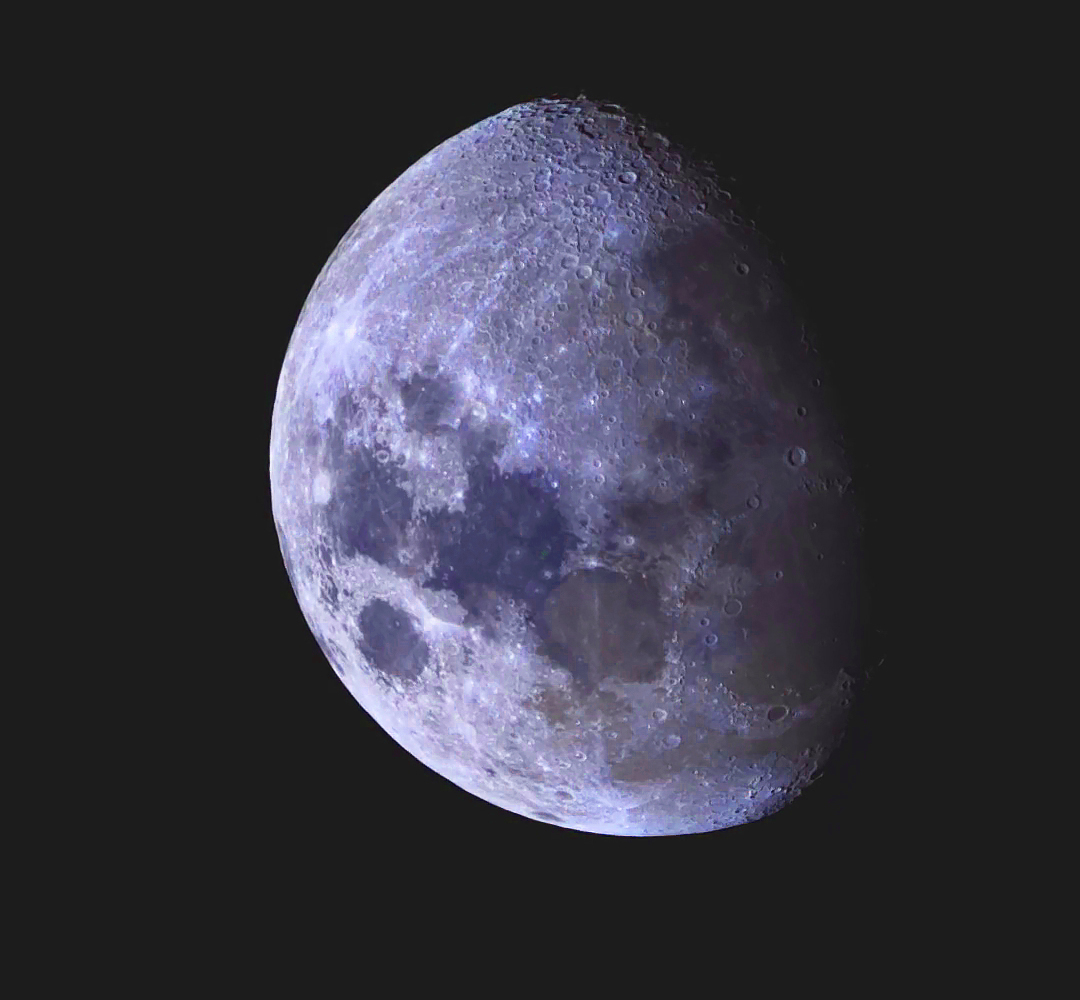
Last night's (June 5th) testing of the Seestar S50 smart telescope. Slight sharpening with Topaz Labs program and saturation adjustment in PS -- normally the Moon seems black and white -- but some "trending" images show a bit of color. I dragged the saturation slider achieving a bit "over the top" result. Not a bad look, though. Maybe think of this sort of adjustment as experimental "jazz." (Right?!) https://www.youtube.com/watch?v=zqNTltOGh5c
After watching the below-linked video, I've decided to re-enhance the saturation, since, as he notes, that adjustment just amps up the already-present palette. Here's that result . . .
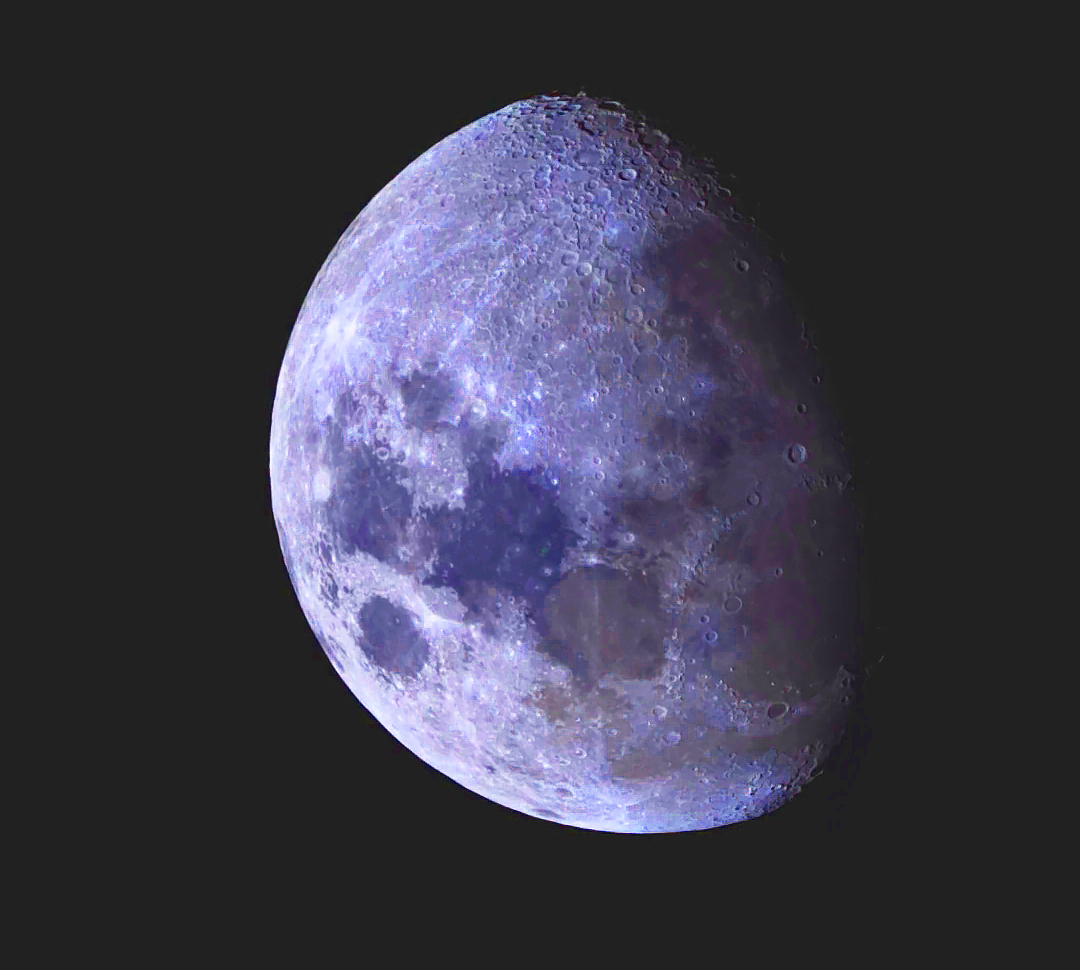
I’m not at all sure which is “better” but watching the video certainly cleared up why the Moon “looks” black & white to the naked eye, but certainly is NOT.
The color photographs are actually more accurate. (Editor’s note -- after reviewing both pics for a while I now PREFER the more colorful one! Or maybe not.)
https://www.youtube.com/watch?v=c-u0oLJB0vs -- an informative scientific discussion of why the Moon actually does exhibit color.
On the day of June 7, 2025 I decided to try the Seestar S50 with the new aiming apparatus and by using the supposedly better and industry-standard Baader film filter also provided by that Etsy creator. Below is the result.
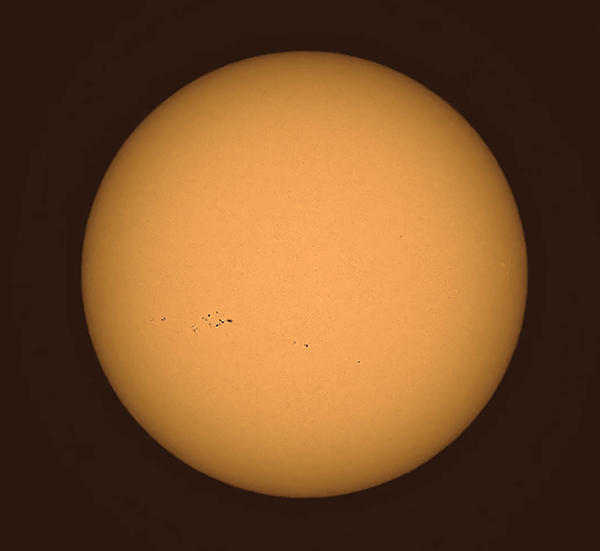
I got the nice mellow color after the fact using several photographic filters in PS. Also, I employed mild sharpening and noise reduction routines, also as layers in PS. Finally, I brightened up the image a bit with levels as well.
I think I agree with the Etsy creator that this filtered image is a bit better than the ones produced by using the provided ZWO orange filter. I did not use any movie/stacking routines, instead using just one of the better single .jpg images.
Death of Mr. Eclipse, Fred Espenak
It is sad to report the passing of this giant, not only of eclipse viewing, but of wonderful astrophotography and spirited writing. Everyone who has observed (especially) total solar eclipses knew him and/or has used his information for their planning and execution of their expeditions. I have used his maps and suggestions on virtually all of my eclipse observation adventures (six fully successful visits into the shadow for me). A huge loss.
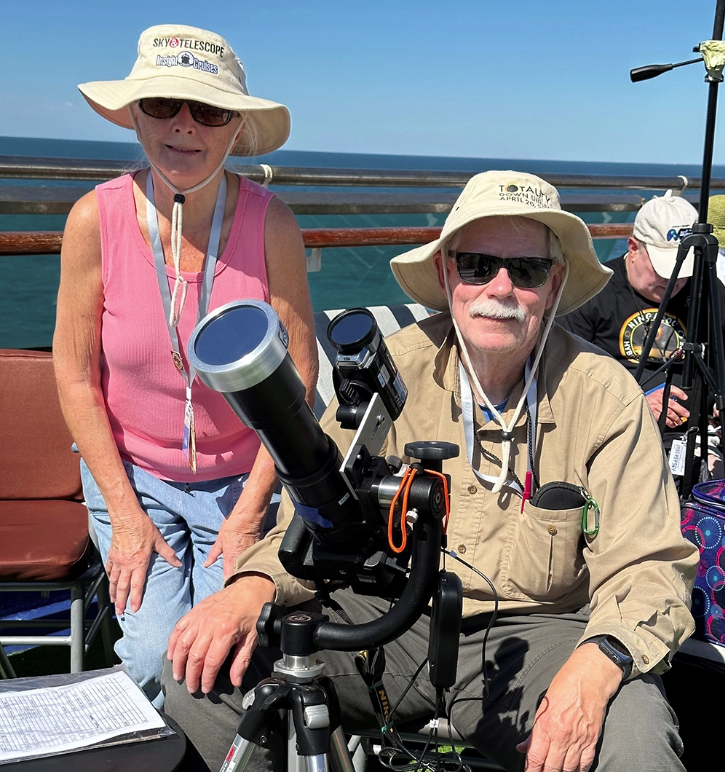
(link and photo from Sky and Telescope magazine)
Observing Log -- new Seestar S50 smart telescope and initial results
Late May, 2025 addendum to initial Seestar post as below / this new report from today’s (05-30-2025) Facebook post
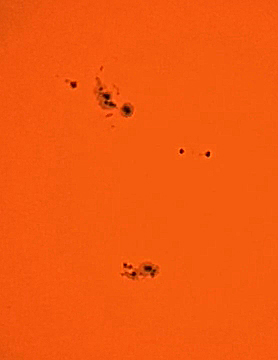
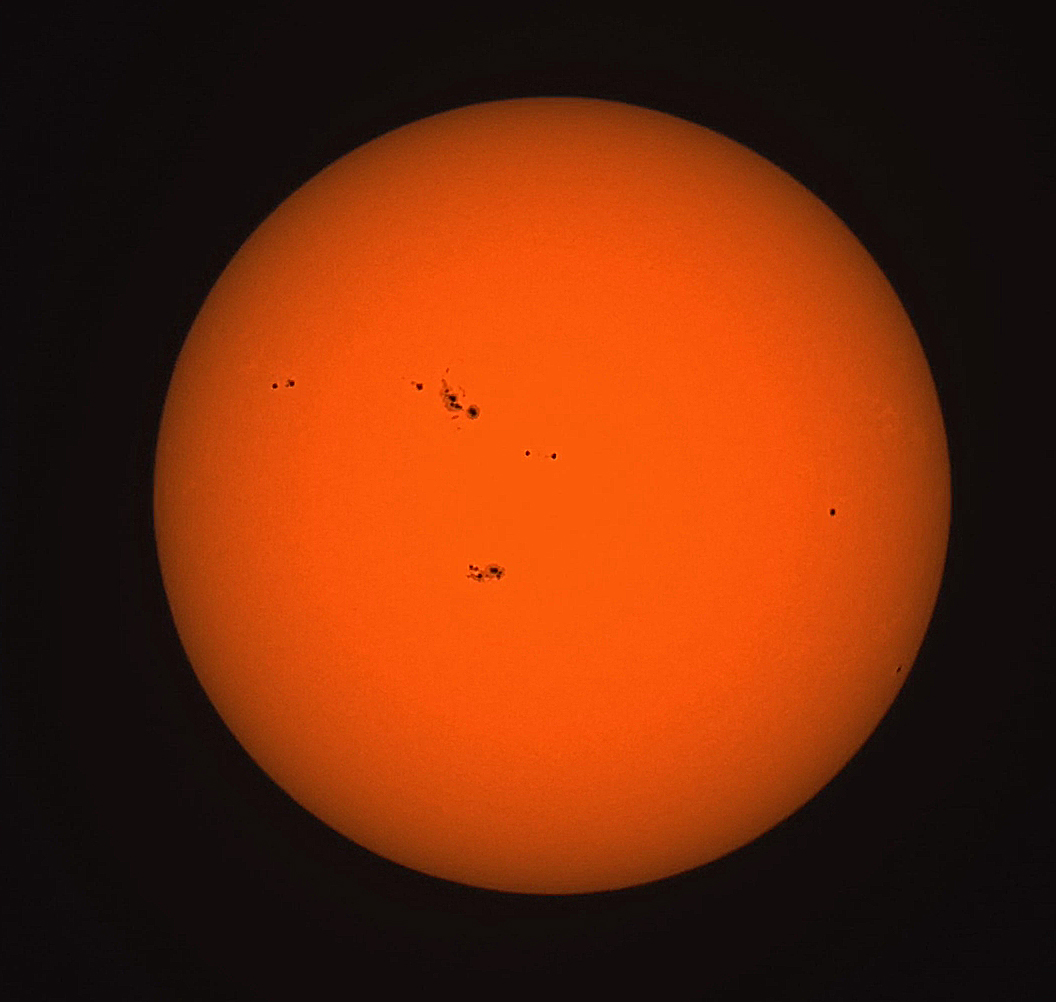
The employed Seestar S50 setup locates and aims at the object automatically -- a little aiming adjustment with the Sun was necessary here; the Sun is possibly an object more difficult to find than most, since you can't look through the optics (duh!); instead it just requires lining up using the Sun's shadow and the mount's ‘phone-accessible digital "joystick" to control the mount. The only post-exposure image adjustment was a little bit of sharpening and brightening and the final crop. [Obviously the solar filter is in use, virtually opaque and orange (duh!)]. On the internet you can look up "live" solar activity and predictions for the aurora based on solar activity. Here the solar image shows quite a few large detailed sunspots, the indication of "more" solar activity with possible magnetic ramifications, especially in the north (Canada and northerly states). Close up of sunspots above, whole disk below -- fits perfectly into the Seestar S50’s FOV. Full Sun slightly cropped top and bottom only.
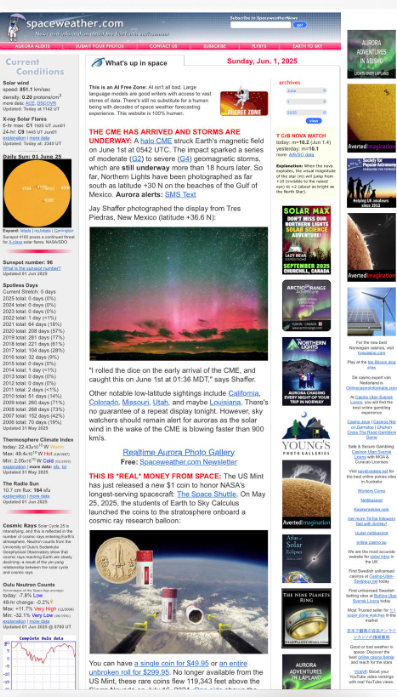
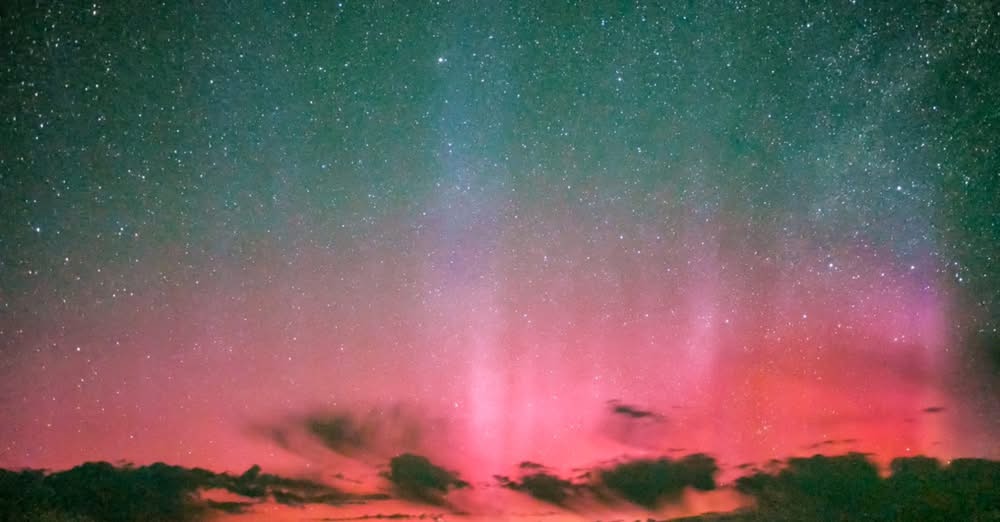
Per the above discussion vis-a-vis intense sunspots often are harbingers of following auroral displays, this appeared on spaceweather.com the days after the sunspots were viewed and photographed. Jay Schaffer lives just down the road (and over the gorge) in Tres Piedres, NM, a very dark sky location. Jay has an all-sky camera that records the various sky phenomena every night! This fortunate image was recorded on June 1, 2025 at 01:06 A.M. MDT.
It’s nice to be able to use the Seestar S50 during the day without much hoopla. The most difficult part was figuring out how to move the images from the ‘phone to the computer!
I did use the new Sun aiming accessories, but did not yet use the filter from that same creator/provider, it renders a white Sun image. Perhaps next time. I do like the color the included Seestar filter renders, but that’s easy to alter if desired in PS. I also used the equatorial accessory and set up North with a compass. Tracked well. The pics are also much better than the first image several weeks ago, I believe. I just used the one I thought best -- no stacking.
https://www.etsy.com/listing/1786235343/zwo-upgraded-seestar-s50-solar-filter?ls=r&ref=listing-free-shipping-bundle-1&sts=1&content_source=89cf8bc3e3b756612a4c3f47bc14ddd596e123dc%253A1786235343&logging_key=89cf8bc3e3b756612a4c3f47bc14ddd596e123dc%3A1786235343 -- I purchased for solar viewing
https://petersonengineering.com/seestar-equitoral-ez-mount/ -- wedge link -- likely most stable –- I purchased
May, 2025 Seestar acquisition
These new “smart telescopes” have always intrigued me but like almost everything, I wait. Sort of like my father waiting to get a color TV until the technology was proven. Like father, like son, I suppose.
We watched the (first manned) Moon landing on our neighbor Graham’s (newfangled color) TV, as an example. Or perhaps like me waiting to move into the digital realm in photography. As proven out, my digital photographs (both terrestrial and astro) have far exceeded the quality of the previous film compositions, so perhaps the wait was worth it. Maybe a physical example is pertinent and best. See initial Moon-shot below.
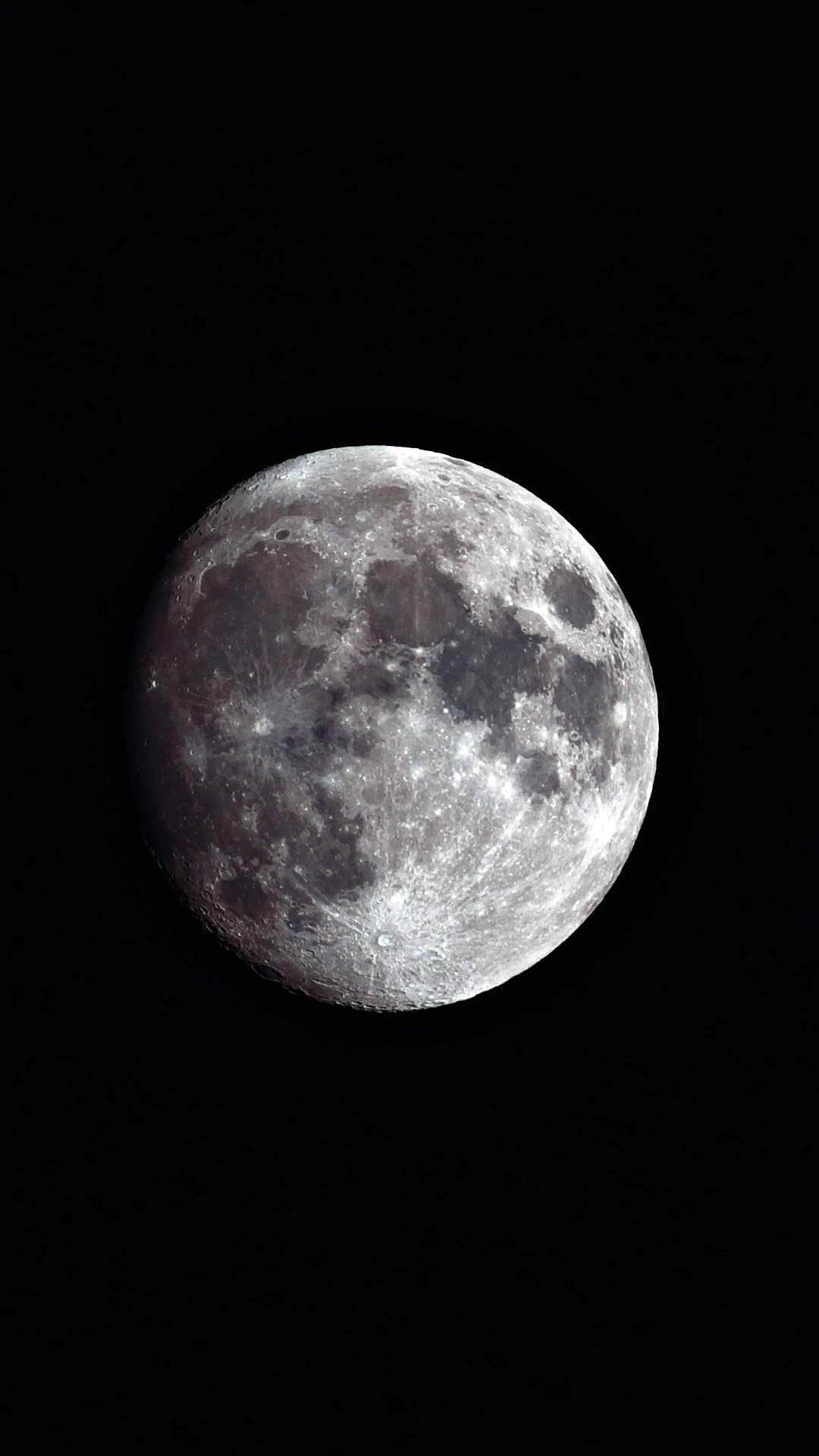
This Moon picture below is the first-light result, admittedly, of some research and trial and error attempts with the Sun earlier in the day. Also, a fumbling with the software and various hook-up issues with the network connection, etc. were present. But for right at this moment, I’d assess the image as an unqualified success.
Details of this experience are below the photograph. The only adjustment is, after downloading the smallish .jpg image from the second ‘phone (“why” more details later), I did bring it into PS for some auto adjustments and some smart sharpening. That’s it.
Continuing, I received the S50 Seestar after eyeing an ad in Astromart, which suggested that the owner would trade a brand-new unopened S50 for a ZWO ASI 533MC Pro USB3 camera, which I had, along with a filter drawer and IR cut filter, a necessity for OSC astro cameras. After some wheeling and dealing, we agreed to the trade -- I reluctantly asked for $200.00 additional dollars as the camera listed for about that much more than the Seestar. He was happy to offer that and even noted that was the amount extra he was intending to pay. A deal was done, and a few days later I received the Seestar. A side note should be that all Chinese goods (including ZWO cameras and accessories, I understand) will be so taxed (tariffed) that such off-grid trades are likely to be much more prevalent in the near future, as the products’ list prices will be substantially higher or even unavailable in our market. See the revealing interview with ZWO’s CEO linked below.
So, after doing some research (see extensive links below –- many more exist!), I set the thing up, loaded the software and worked through the details, really too extensive to review here. Yes, the ’scope and camera are simple enough, but also yes, I still am a little uncomfortable in this fully digital reality, so I stumbled around quite a bit during the immediate learning curve.
Overall, though, it was relatively easy.
At first I tried the Sun during the day. This was difficult as you had to aim everything completely blind, and the scope was not perfectly set up to do this, given that it was light out, so no plate solving could occur. The process did familiarize me with the software nuances, however.
As evening progressed it was at first cloudy and then cleared a bit. That’s when I decided to try again with the large gibbous waxing Moon. I also incorporated the new “wedge” thingy and put everything on a slightly more robust tripod. I used a regular compass to aim the setup north, non-precise of course.
Within seconds the moon was located. I centered the target, auto-focused it several times and took perhaps 10 shots. It turns out that this method creates ONLY smallish .jpegs; if I had shot the optional movie, and per the many instructions suggested, I would have created a much larger and more detailed .avi file or .fit stackable file. I’ll learn as I go.
But, as is plainly evident, even the smallish .jpg image (commonly apparently used in conjunction with the “share” toggle) can be posted/shared on social media, much like the options available with the “prehistoric” ATIK Infinity CCD camera.
So, onward I move with this new camera. Using it has awoken a sort of new passion for the subject, because it is new, slick, works well (I can’t wait to use it on extended objects like clusters, galaxies and nebulae), aims itself, and really is a great bang-for-the-buck piece of equipment. I’m guessing it will perform extremely well on such extended objects as long as I use the correct save algorithm!
Also, I’ve decided to use the second ‘phone (5848) as the “handbox” for the S50. Very functional.
Some of the many Seestar links I have learned from:
https://www.youtube.com/watch?v=coY5sV7pFis -- interview with Sam Wen, CEO of ZWO
https://www.youtube.com/watch?v=jRpLxTu5fq4 -- woman airhead review link
https://www.youtube.com/watch?v=QlLiK-wcLqk -- lazy geek review on EQ mode, somewhat dated
https://www.youtube.com/@CuivTheLazyGeek/videos -- general list of Cuiv videos including many “smart” telescope reviews, etc.
https://www.unofficialseestar.wiki/lib/exe/fetch.php?media=seestarv08sml.pdf -- unofficial guide
https://store.seestar.com/blogs/tutorial/equatorial-mode?srsltid=AfmBOorYHlwC81XrL9Tad-k6QjuCAPVwM7iDuv4KQlCKxw1XPPATJTtm -- SeeStar official tutorial
https://petersonengineering.com/seestar-equitoral-ez-mount/ -- wedge link -- likely most stable –- I purchased
https://www.amazon.com/dp/B0B185C7KP/ref=dp_iou_view_item?ie=UTF8&th=1 -- tri-leveler -- I purchased
https://www.etsy.com/listing/1786235343/zwo-upgraded-seestar-s50-solar-filter?ls=r&ref=listing-free-shipping-bundle-1&sts=1&content_source=89cf8bc3e3b756612a4c3f47bc14ddd596e123dc%253A1786235343&logging_key=89cf8bc3e3b756612a4c3f47bc14ddd596e123dc%3A1786235343 -- I purchased for solar viewing
I also purchased a lens cap and Bahtinov mask for precise focusing.
https://agenaastro.com/catalog/product/view/id/10632/s/seestar-s50-all-in-one-telescope-by-zwo/?gad_source=1&gad_campaignid=20883237026&gbraid=0AAAAAD_aP9IQq-kYQmdVmGhNgO6XmrKU0&gclid=EAIaIQobChMI4YrtubGZjQMV6QKtBh1Uhyk5EAQYASABEgLzyfD_BwE -- review
https://astroforumspace.com/seestar-s50-smart-telescope-review-tutorial/#:~:text=The%20photo%20mode%20is%20perfect,the%20Sun%20or%20the%20Moon. -- extensive review of Seestar S50
https://www.google.com/search?q=processing+image+SeeStar&oq=processing+image+SeeStar&aqs=chrome..69i57j0i22i30l2j0i390i512i650l3j0i751l4.9619j0j7&sourceid=chrome&ie=UTF-8&sei=gfQbaP-QAb2y0PEPvfzCiA8 -- search link for processing
https://www.youtube.com/watch?v=Ao812ZCFOtM -- processing images in Seestar
The next day I tried the Sun, first auto-aiming and then adjusting by using an old solar finder (1X) attached by Velcro to the Seestar. No problem this time, aimed up rather easily, and tracked well too.
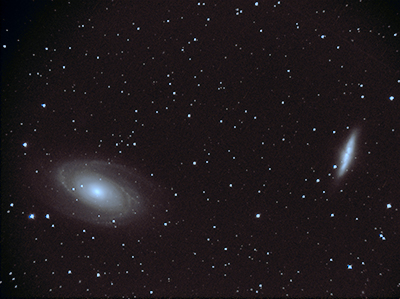
Observing Log -- M81/82 and adjacent Galactic area [Bode (center) and Cigar (left) Galaxies in Ursa Major] -- March 23, 2025
My son Larry and his wife Jaci visited for the weekend, and he experimented with his new telescope and imaging rig. Details below. On Friday night he shot some images of the Flame and Horsehead region in Orion. Although no great images were obtained, he learned about his new telescope and its nuances. Saturday night was cloudy, but he was at it again on Sunday night, the 23rd. Below is his final result, with data below it.
-copy copy.jpg)
(image ©Lawrence Greiner 2025)
ISO 1600
40 lights @ 60 sec each
10 dark frames
10 flat frames
10 bias frames
Explore Scientific
iexos-100 mount
Nikon D5100 Stock
SvBony SV48p 90 mm telescope
SV193 Focal Reducer 0.8X Field Flattener
effective Focal Length 400
effective focal ratio f/4.4
3-23-2025
Bortle Class 3-4 El Prado, NM
Plate solving and image acquisition in N.I.N.A. and BackyardNikon
Stacking, Post Processing done in Siril
Denoise and sharpening in Topaz Photo AI
For an interesting comparison between the skies here in Taos (likely more like Bortle 3 skies given the access to obvious Zodiacal Light (we observed it during this imaging session!) observations in the west after dusk in springtime), please go to Larry's astro website. He has this image presented with a slider between this darker sky image with his bright suburban sky (Bortle 6). Interesting.
Observing Log -- M45 (the Pleiades and adjacent star field) -- November 19, 2024
When my sons Larry and Seth visited in November, Larry brought his Nikon camera, tracking Explore Scientific mount and mostly his expertise on several new astrophotography computer programs, N.I.N.A. and Siril. After some electronic roadblocks (temporary) we got down to Larry teaching me about Plate Solving (amazing!) while taking a sequence of photographs of the Pleiades with his rig. Below is the final combined result, data below the pic . . .

(image ©Lawrence Greiner 2024)
ISO 3200
f/5.6
41 lights @ 30 sec each
28 dark frames
18 flat frames
25 bias frames
Explore Scientific iexos-100 mount
Nikon
D5100
Stock 135mm Nikkor Lens
Bortle Class 3-4 El Prado, NM
Stacking, Post Processing done in Siril
Denoise in Topaz Photo AI
For an interesting comparison between the skies here in Taos (likely more like Bortle 3 skies given the access to obvious Zodiacal Light observations in the west after dusk in springtime), please go to Larry's astro website. He has this image presented with a slider between this darker sky image with his bright suburban sky (Bortle 6). Interesting.
Observing Log -- Comet c/2023 A3 Tsuchinshan-Atlas -- October 21, 2024
I think this will be the last photographic entry vis-a-vis this comet, as it is fading a quite a bit as it moves into the dark night sky; viewing it is best before the bright gibbous moon rises. I have located it on every clear night since the initial photographic session on October 14th. Last night I set up on the side patio about 7:30 PM MST, at first witnessing the yipping of several coyotes (it's good luck!), just like the first night out near the gorge bridge. The sky was very clear and far darker -- but the comet was nevertheless far less visible as it receded from the Sun, although still detectable with naked eye using indirect averted vision. After some shots of just the comet, I decided also to get horizontal and include the emerging yet setting Milky Way through Scutum and Sagittarius. For that shot I used the wide-angle 14mm f2.8 near fish-eye Rokinon lens. Photos below were converted to black & white -- with shooting data below as before. And here is a link to a nice simple explanation of the comet and its changing position . . . https://www.youtube.com/watch?v=tFudc0b7MUs
|
|
| October 21, 2024, 7:43 PM MST, Nikon D5500 with 35mm f/1.8 lens, shot at f/2.8, ISO 3200, 8 second exposure |
October 21, 2024, 8:11 PM MST, Nikon D5500 with 14mm f/2.8 lens, shot at f/3.5, ISO 3200, 13 second exposure |
Observing Log -- Comet c/2023 A3 Tsuchinshan-Atlas -- October 20, 2024
After all of the post-processing of my two (so far) final comet images, it is instructive to compare the two vis-a-vis the comet's path through the background stars and away from the Sun.
|
|
 |
| Note the positions of the two colorful stars on the left side 1/3 of the way down this photograph, adjacent to the "top" of the comet's tail and slightly to the left of the clouds. |
Just several days later, note the same two stars' position on the left but now below the comet entirely. |
Western Colorado, circa 65 million years ago (artist's depiction, some AI may have been used). |
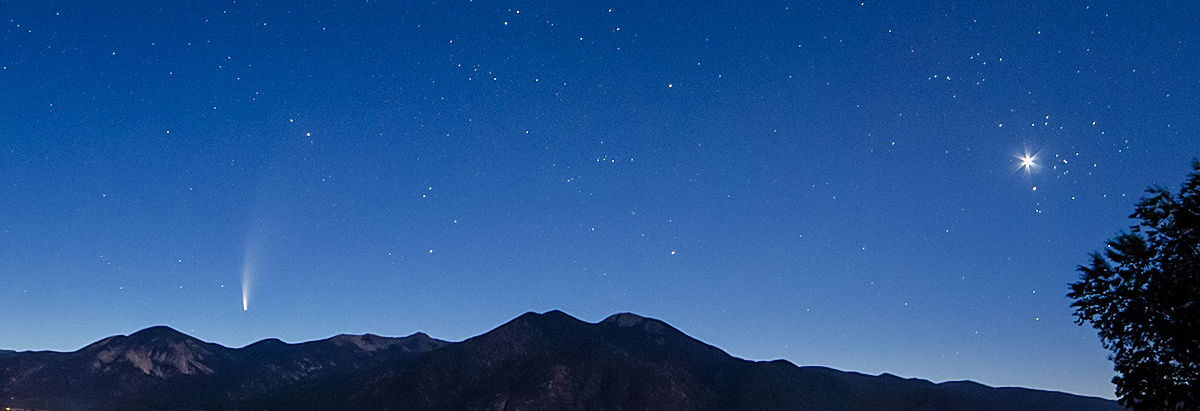
The comet has moved into an area in what is now (second photo 10-18-2024) the night sky by a distance of perhaps >15 degrees against the star background. That is why the comet now appears in a darker night sky area, not in the evening twilight. Unfortunately, because the comet is moving so quickly away from the sun (by comparison, Comet Hale-Bopp and gallery linked here stayed in a convenient early evening position for weeks), it is also dimming and the tail will appear to be shorter (although not by much -- this is frankly is a significant comet). Both images, when enlarged, do still show the downward-pointing anti-tail, debris left in the wake of the comet's very fast retreat from the Sun. |
Observing Log -- Comet c/2023 A3 Tsuchinshan-Atlas -- October 18, 2024
On the evening of the 18th of October it appeared as if it was going to be quite cloudy (it rained later that night), but about 7:15 PM MST I looked out and it was very clear to the west. I quickly set up on our side patio with a tripod and the Nikon 5500 and f/1.8 35mm lens as below. Because it was a little later (photo taken at 7:50 PM MST), and the comet (still naked eye, but dimmer than on Monday evening) was higher in the sky, the background appeared much darker. Also, the gibbous waning Moon was phasing later in the month by several days. The resultant photograph is below, along with a locational star chart from the BBC. Note open star cluster IC4665 in upper left corner.


Comet c/2023 Locational Star Map (BBC internet source)
Observing Log -- Comet c/2023 A3 Tsuchinshan-Atlas -- October 14, 2024
I got home to Taos on October 14, and even though I was somewhat exhausted from the drive from Denver, it was relatively clear, so I decided to try to image the bright comet in the evening. I decided (while showering!) to go the picnic area just beyond the gorge bridge as that location would exhibit great horizons. I also liked its conveniences and ease of set up. I used the Nikon 5500 with a 35mm f/1.8 lens. I forgot a headlamp, but borrowed some other folks’ ‘phone flashlights to get the focus right (no infinity stop on the camera) and other essential settings. I set up on the Manfrotto tripod, and starting shooting about 7:15 MST. Shooting details below:
2023A3 Tsuchinshan-ATLAS capture from near the Rio Grande Gorge Bridge, Taos County NM, October 14, 2024, 7:29 PM, Nikon D5500 with 35mm f/1.8 lens, shot at f/2.8, ISO 1600, 8 second exposure.
I did many photographs, but did not combine any, instead just choosing what I considered the best shot and them processing it the next day. I went through several stages, using Lightroom, various level adjustments, applying Topaz Photo AI, and then doing a bit more processing in Photoshop. The end result (including one set of a spotting exercise to remove the one satellite I captured and shown in the lighter photograph) is below -- the main photographs have the various layer adjustments saved before the final save. Top image below is the first effort, a bit light I thought. Below that is the final effort, at least for now. It is also a more accurate representation of the actual sky color and darkness at the time of the photographs.


Note in both shots the length of the tail and most especially the rare anti-tail, extending downward. It is the debris "dropped" within the comet's orbit as it moves through space, and likely in the future will develop into a new meteor shower at this time of the year as the Earth moves through the comet's debris field.
This tail measures >15 degrees long -- longest comet I have seen since Hyakutake in 1996 (additional multiple image links here) which in my photos and observations displayed a tail between 60 and 80 degrees long (i.e. almost one half of the sky)! I remember being able to see it from the insanely lit Safeway parking lot in Conifer, CO. I have a composite photograph named "A Quarter Century of Comets." I guess I'll have to make a new one entitled "A Half Century of Comets." Back in the day you had to take quite long time exposures (at least 2 minutes) with hyper-sensitized black and white film or extremely fast (and grainy) color film -- the above pic is 8 seconds, on a tripod of course!
Below are locational star maps/charts.
|
|
location of Comet c/2023 in the sky |
star map of Comet c/2023 in early October, 2023 |
Observing Log -- Larry's latest effort -- Heart (above) and Soul (below) Nebulae (Cassiopeia) and the Double Cluster (upper right / Perseus) -- October, 2024

All the details on on Larry's new website, accessed here. Check out all of his astrophotographs on his developing website.
Observing Log -- Larry's Veil Nebula Complex-- late September, 2024

(image ©Lawrence Greiner 2024)
Camera -- Nikon D5100
Lens -- 135mm Nikkor at f/5.6
Mount -- ES iEXOS-100 PMC-Eight Equatorial Tracker System
Here is my "finished" image of the
Veil Nebula complex. I'm thinking I want to add some additional broadband data to it also but this is what I have so far.
2 nights total using only the SV220 dual narrowband filter - Ha & OIII
1st night
--------------
ISO 1600 @ 90 secs
60 lights
60 darks
20 flats
20 bias
2nd night
--------------
ISO 1600 @ 180 secs
52 lights
15 darks -- something strange happened and the camera did not save the darks, not sure why so I pulled darks from a different night/subject that was around the same temp outside and was at ISO 1600 @ 180 secs. I'm sure this hurt me a little but I did not have a lot of options.
20 flats
20 bias
Total integration time ~4 hours.
processed in Siril and Photoshop, and as always used Topaz for noise.
Observing Log -- Larry's North American Nebula/NGC7000 and associated Cygnus region including the Pelican nebula -- late August, 2024

(image ©Lawrence Greiner 2024)
click the above photograph to see a far longer and more detailed exposure of the region while employing a large astronomical telescope
Data is below:
Camera -- Nikon D5100
135mm Nikon lens with light pollution filter at f/5.6
Mount -- ES iEXOS-100 PMC-Eight Equatorial Tracker System
ISO 1600
60 lights/~56 used by Siril software
180 seconds per image
All calibration frames -- 15 each (darks, flats, and bias)
imaged from suburban Denver area -- Bortle 6-7
Stacked and preprocessed in Siril
Additional post-processing with PhotoShop Lightroom and Topaz Labs deNoise AI, Gradient XTerminator
Notes:
Blue star to the right is Deneb -- see charts below (© from the internet) for location
Observing Log -- Larry's M31/M32/NGC205 -- August, 2024
Here is my younger son's most recent effort -- imaging the Andromeda Galaxy and its companions (external link here)

(image ©Lawrence Greiner 2024)
Data is below:
Camera -- Nikon D5100
135mm Nikon lens with light pollution filter
f/5.6
ISO 800
iexos-100 mount
17 images
180 seconds per image
Dark only calibration frames (no flats and no bias)
imaged from suburban Denver area -- Bortle 6-7
Stacked and preprocessed in Siril
Additional post-processing with PhotoShop CS6 and Topaz Labs AI programs
Observing Log -- deep-sky video session June 03, 2024
After much preparation and some additional review of procedures, I took part in a video session on the above date, employing the Atik Infinity camera and the superb Explore Scientific .7 reducer/corrector. I set-up an observing/video session using an updated version of the AstroPlanner software. In order to photograph such objects, I had to rise at about 12 midnight on June 02/03. Below are the results . . .
|
|
Globular Cluster M13 in Hercules -- note dim galaxy bottom left |
M8 Emission Nebula and Star Cluster in Sagittarius |
|
|
M16 Emission Nebula in Sagittarius |
M17 Emission Nebula in Sagittarius |

Overall I'm quite happy with the results, although in order to coax out some of the details and to reduce noise and sharpen the images, I worked a bit with Photoshop and the magical Topaz Photo AI. Colors were barely modified as, to my eye, are rather accurate. All photographic screen grabs are then shot at ~f/5.25 and consist of ~15 stacked images; exposure times are 10-15 seconds per exposure. Note transit (highest in the sky) times for various subject photographs. I did not photograph M20 or M11 this time around. I have linked to larger versions of these images on the video page.
Observing Log -- Larry’s Aurora -- May 11, 2024
My younger son Larry, armed with his Nikon D3500 and a tripod, woke up very early on May 11, 2024 (after receiving a call from a photo buddy), and traveled from the Highlands Ranch area of metro Denver east out to Deer Trail (see map below, just west of where his friend and he typically set up in Last Chance), and where Larry then exposed several dozen photographs. Data is below; one of which is just a straight-ahead conversion from Camera Raw/Lightroom-Photoshop. Main adjustments were Clarity and DeHaze in Camera Raw/Lightroom, and then, moving over to Photoshop CS6, applying a bit on Level adjustment and amping up the Saturation a bit. I ended up backing off of that initial saturation effort, which involved too much intensity. The Clarity sharpened everything up a bit and revealed more than a few stars -- the DeHaze remarkably enhanced quite a bit the rays of the Aurora Borealis. Below is the result of just this frame. Many were as good as this one.
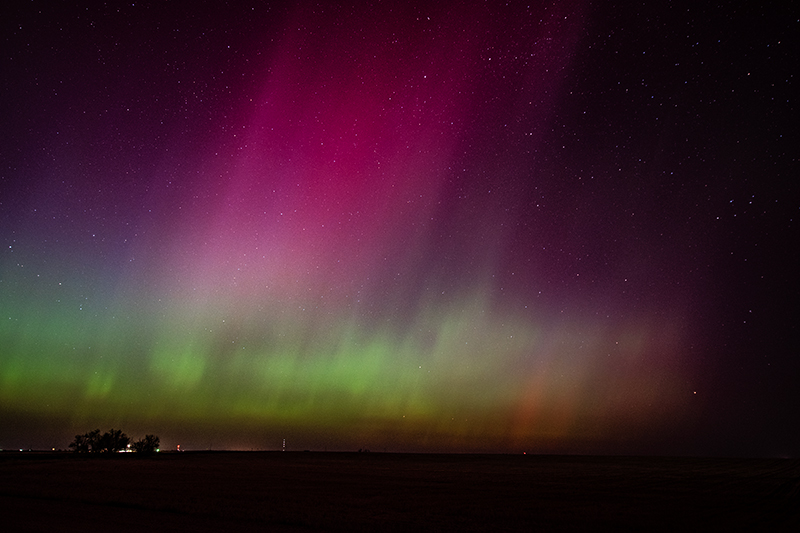
Nikon D3500 (cropped sensor) shot with a 10-20 mm lens @ 17mm f/4, 20 second exposure @ ISO800.
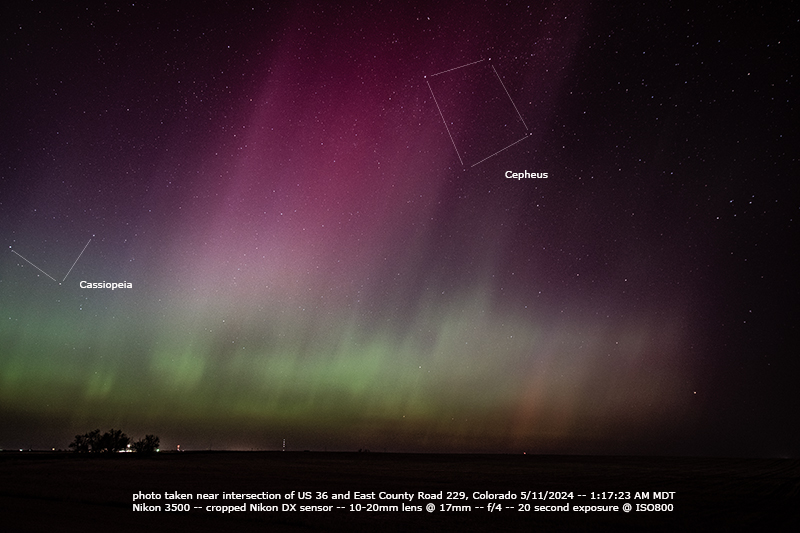
(both images ©Lawrence Greiner 2024)
Above is a cropped and annotated version of the same photograph. Constellations of Cepheus and Cassiopeia are marked and visible.
Larry noted that with the naked eye, very little of the Aurora was visible, and none of the red coloring or curtains could be seen. And these exposures are “only” 20 seconds shot at a rather conservative ISO800. With film, and even with extreme “pushing,” nowhere near as much Aurora would show, and intervening skylight and “fog” due to much longer exposures would undoubtedly be present.
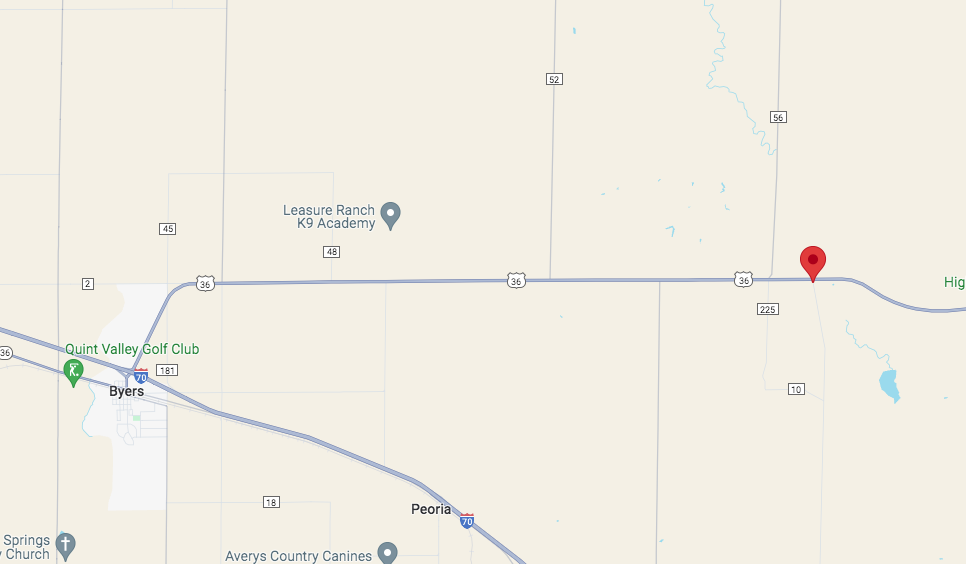
(from Google Maps)
Observing the Total Solar Eclipse of April 8, 2024
Recently a group of family, recent friends, old friends, even older high school friends and families, rafting and adventure buddies, and generally a group of aging beatniks, mischief-makers, and ex-thrill-seekers gathered at an AirBnB in Fredericksville/Luckenbach, Texas to observe, in my case a sixth (!) Total Solar Eclipse. I am now in the process of creating an observing log, gathering up people and places images, communicating with the participants (32 of us!!!), and even assisting my younger son Larry with the images he collected with his Nikon 3500 and telephoto lens mounted upon the below-described tracking unit. But since that will take some time, I thought that I would at least present his initial composite image. This project will eventually take up several pages on the website, but for now behold . . .
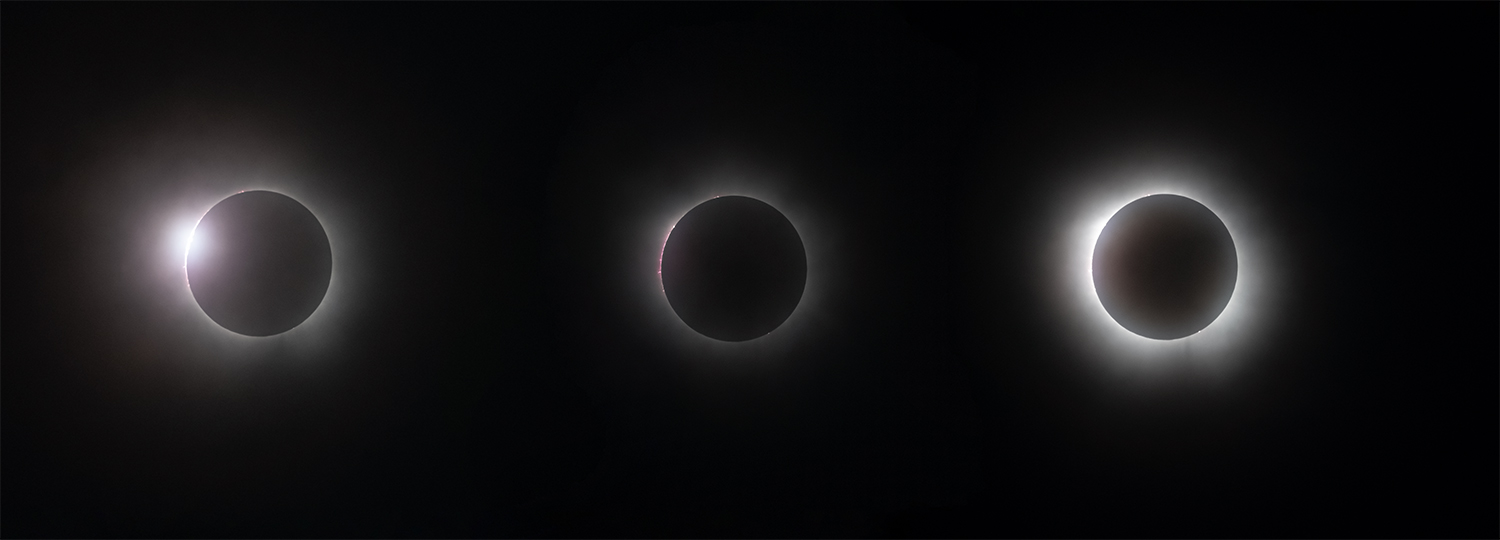
©Lawrence Greiner 2024
(All images here f/6.1, 1/40 second, ISO 400 with Nikon zoom 270mm telephoto lens.) Of course, all of the pertinent details and many other images he managed to obtain (between the challenging cloud cover) appears by link here! Larry is allowing me to take part in some of the post-processing! Click here or on the composite above to link to the detailed individual photographs.
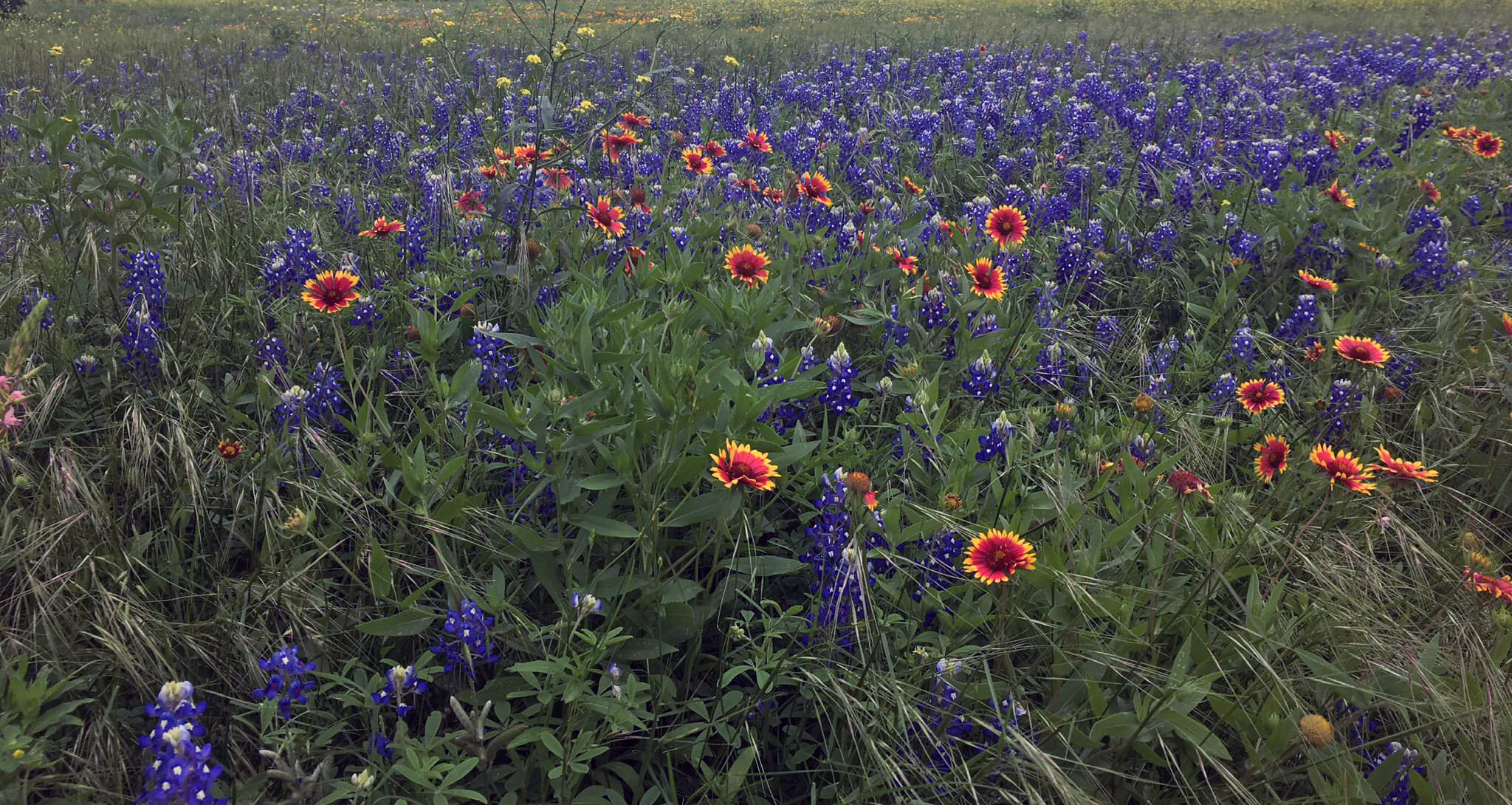
©Seth Greiner 2024
Texas Bluebonnets Spring bloom -- "the two predominant species of bluebonnets are found growing naturally only in Texas and at no other location in the world."